Category Archives: My Homeplace

U CAN® Watering System

U Can is pretty, easy to carry and just the right size.

It’s hard to impress me when it comes to watering cans. I have my favorites in different sizes for different uses. After years of gardening, I have some definate preferences when it comes to watering cans.

I like the new 2 gallon U CAN. I like it’s ergonomic design and generous water capacity.

U CAN has a sprinkler head storage post. That’s sure handy for me because I tend to misplace the rose or sprinkler heads on watering cans. I’ll use the glove jam to keep my bandanna handy.

There is handy fertilizer storage and measuring spoon. That’s great for my hanging baskets and containers on the patio which get fertilizer every week.

Though not a deciding factor in buying a watering can, I like the dial fertilizer tracker and the built in measuring spoon.  It’s a little thing that makes this watering can a keeper.

I keep this watering can handy, it stays on my patio gardens near the containers.

I like that U CAN is made in the USA with recycled plastic.

The hand grips are comfortable and perfectly placed.

U CAN lists these advantages in the translucent plastic watering can:

  •  fertilizer storage chamber,
  • built-in measuring cup and spoon,
  • fertilizing reminder dial,
  • glove jam to store your gloves,
  • sprinkler head storage post.

The U CAN 2 gallon watering can is ergonomically designed with rubber hand grips and a textured handle for easy lifting, carrying and pouring. A perfect gift for gardeners, you can buy U CAN online or at these garden centers.

Time for Four o’clocks

Many people have memories of four-o’clocks in their family garden. These beautiful flowers have been popular plants for generations.

photo Renees Garden

Four-o’clocks (Mirabilas jalapa) self seed. Often you can find them still growing in a long-abandoned garden spot. It’s an old Southern tradition to plant them near the front door. These jasmine-scented flowers will greet your guests.

In South America, where these flowers originated, four-o’clocks are used as a dye. The root is used medicinally and is said to be a hallucinogen. In herbal medicine, parts of the plant may be used for diuretic, purgative or vulnerary (wound-healing) purposes. I can’t speak for any of these herbal or medicinal uses—I have only enjoyed the flowers and their fragrance.

I’ve also read that the flowers are used in food coloring. The leaves may be cooked and eaten as well, but only as an emergency food. An edible crimson dye is obtained from the flowers to color cakes and jellies.

7-26-2011-four o'clocks
Four-o’clocks are also also known as the ‘Marvel of Peru’.
Photo courtesy
Renee’s Garden

Four-o’clock ‘Broken Colors’ are a special variety with starry, 2-inch blossoms that are beautifully splashed with showy, contrasting colors. Their delicio7-26-2011-renee's garden four o'clocksus jasmine fragrance floats on summer breezes. These flowers are both easy to grow and reliable. You can find the seeds on Renee’s Garden’s website for $2.79 a packet.

Before planting, soak the seeds in water overnight to speed the sprouting. These flowers are trouble-free, love full sun and have only moderate watering requirements.

Your four-o’clock flowers probably won’t bloom at exactly 4 p.m. Mine bloom at about 6 o’clock. The blooming time depends on your time zone and the plants’ exposure, but whenever it blooms it will stay consistent. You can count on your flowers to bloom at the same time every day. However, if it is cloudy or rainy, it may throw their solar clock askew.

A First Look at Superbells, Calibrachoa

Superbells Grape Punch

Superbells Grape Punch, a Calibrachoa hybrid introduced by Proven Winners is attracting hummingbirds. Photo PBH

I couldn’t wait to tell you about this little petunia-like flower because the humming birds and I have already decided this is a perfect plant for my patio. It’s continuous color with no added work.

I’ll blog about Superbells Grape Punch, a Calibrachoa hybrid, after it withstands our dry, hot, humid August in Southeast Missouri. (zone 6) It is supposed to look good through fall, until that first hard frost.

Calibrachoa hybrid, summer-long little fade proof purple trumpets. photo: PBH

Last summer, I told you about my patio Containers – Calibrachoa and Coleus  and Look For This Plant Superbells® Coralberry Punch Calibrachoa, so, I am familiar Calibrachoa.

It is my honor to trial Superbells® Grape Punch, for Proven Winners this summer. Read more about this annual after the trial.

Zucchini. Stuff it.

I just saw my neighbor run inside and turn out the lights. It was quite a sight. She is 90 and I had no idea she could move that fast. I think she saw me coming over with a basket of zucchini. I was going to leave it on her doorstep but I was afraid she would trip over it and fall down. In my head I hear, “You killed my mom with zucchini!”

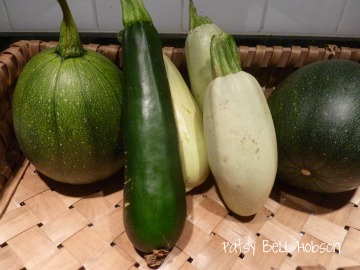
Tatume – a Mexican variety favored in Texas, Raven – a traditional variety, and Clarimore, a Mediterranean squash.

So when Jules came home from work, he asked what’s for supper.

“zucchini casserole and zucchini slaw with pickled zucchini!” I said.

But we had toasted zucchini bread for breakfast, Jules whined.

“with zucchini jam!,” I reminded him.

Well, what’s for desert? he said.
“My famous and delicious chocolate zucchini cake!”

I was thinking that if I sounded excited about it (hence the exclamation marks) he would be excited about eating our fresh from the garden bounty.

Tomorrow, let’s go out to dinner, he said.

“I can’t! I can’t leave the zucchini that long. They will be two feet long by the time we come back.”

Last night, he put his foot down when he came into the kitchen and saw me with a recipe for making zucchini wine. (We went out to dinner.)

This is the first year I can remember having too much zucchini. Usually the squash bugs and squash vine borers attack the plants well before the zucchini get into peak production.

Clairimore is a Mediterranean squash, a nutty flavorful variety with pale green skin.

We have a house rule, if it’s too big for one person to carry into the kitchen,  just roll it over to the compost pile.

Does Ripley’s Believe it or Not! have a zucchini record? If so, I think I have a contender.


Here are some real suggestions on how to manage your harvest.

Local Cook suggests “Hide it in desserts, such as Zucchini Brownies. Chocolate, like cheese, makes everything taste better! This brownie looks good enough to eat.

There’s an app for that
Just go to the iTunes store or Android marketplace or search for “Produce Converter”

You can’t go wrong with a Julia Child recipe. Julia Child’s Grated Zucchini sautéed in Butter and Shallots From Food.com

My bountiful harvest is from seed I got at  Renee’s Garden. She just posted Zucchini pancakes recipe AND a photo contest.

Garden Bloggers Bloom Day July 2011

Lily

Greeting guests at the front door.

Black tea with lemon mint

Black tea with lemon mint

“Mosquito is out,
it’s the end of the day;
she’s humming and hunting
her evening away.
Who knows why such hunger
arrives on such wings
at sundown? I guess
it’s the nature of things.”
–  N. M. Boedecker, Midsummer Night Itch

Welcome! Thanks for stopping by. Join me on the patio for tea with mint. or lemon balm.

Orange Day Lily

So many of my esteemed fellow garden bloggers have names on every flower. Not me. I am clueless about the lovely lillies. Some were here when I moved in this house, some were gifts or I found them in a sale bin.

Lily

Standing alone, flowers about five inches across, plant about six feet tall, this gangly lily begs for a new home.

My house is 170 years old. There are lots of things growing on this little acre that I haven’t identified.

There is a big black snake living in the North East corner. I think we’ve never had a problem with mice because of that big snake. He is not in the picture because he lives in the Poison Ivy Patch.

I think next bloom day, I’ll have sunflowers to share. There are lots of pollinators (like honey bees) this year. I am not seeing many ladybugs and I sure could use some bungry ladybugs.

There is a killer black cat next door that kills the song birds that I feed and invite into my garden. Yes, it poops in my garden and spends a lot of time in my garage and on my patio. Every day.

Raddish Flowers

Raddish with seed pods and flowers

Have you ever seen raddish flowers? I let a few go to seed, just so I could see the whole life cycle of the annual that is alsways in my spring garden.

Inspired by the words of Elizabeth Lawrence, “We can have flowers nearly every month of the year,” Carol of May Dreams Gardens started Garden Bloggers Bloom Day. On the 15th of every month, garden bloggers from all over the world publish what is currently blooming in their gardens.

I call these the house lillies because there are a lot of them and they came with the house.


Small blooms, but the flowers just keep on coming for days


in the front yard, along the front porch, several spiky lilies want to be in a better designed garden spoce.

Double your tomato production

Try cloning tomatoes

tomato stem

Clip tomato branch. Remove flowers to encourage root growth.

To extend the tomato season, consider cloning your favorite tomato plants. The new plant will produce tomatoes just like it’s parent.

Here in the heartland, zone 6 we are about half way through the summer growing season. I think I have about two and a half months left before our first frost.

If you haven’t planted tomatoes yet, ask a gardening friend for a cutting of their tastiest plants. As I stake my tomatoes, I zometimes break off unruly stems that won’t be supported by my tomato stakes.

Carbon

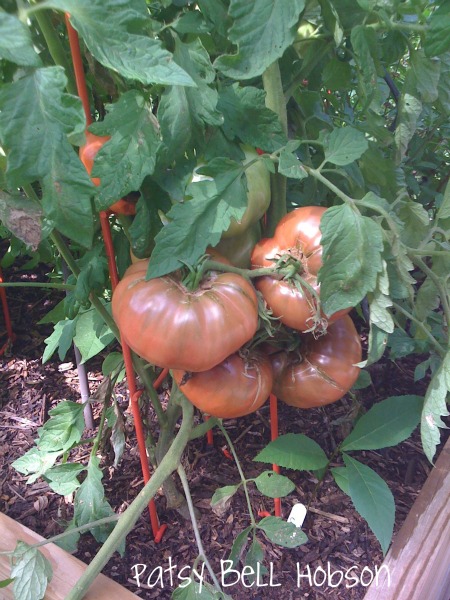
This heirloom started out as a cutting. The plant produced as heavily as the parent plant.

Put that broken tomato plant branch, or cutting directly in the ground at least six or eight inches deep. Place a stake beside the stem. The big tomato stake or cage will stand as guardian over your little cloned tomato plant. Since this new plant has no roots yet, you MUST keep the soil well watered. At first, the cutting or broken branch that you stuck in the ground, will be limp. Don’t give up. Keep watering the planted stem at least twice a day. Shading your cutting will reduce the stress as your new tomato plant starts making roots.

Cloning plants will get you tomatoes faster than starting from seed at mid season. It is too late to start tomatoes from seed.

I broke off a branch of a Carbon tomato plant about a month ago. The black heirloom tomato plant is named Carbon and I am happy to have more of these large, rich tasty tomatoes.

Starting warm season plants midsummer, means that fruits will be developing during the cooler, end of summer weather. Be prepared to cover or protect the heat loving tomato plants during cool nights.

Dragon Wing™ Red Begonia

will reach a maximum height of 14 to 16 in.

Dragon Red Wing Begonia will reach a max height of 14 to 16 in. photo Patsy Bell Hobson

The early show in the garden this year is Dragon Wing Red Begonia. I planted them in two places, a hanging basket of three plants and three more in the planter near the mailboxes. At first the 3 begonias in the planter looked lonely. But the plants filled in and are looking better every day. I’m promised these begonias will still be here till first frost this fall. I think they would add drama and color to a mixed annuals container.

Place these bold beauties in pots, baskets and beds. I would use Dragon Wing Begonias again as an informal bedding or border plant. These exotic looking Begonias hve loose loose clusters of Red stop-and-look-at-me blooms. Glossy green, wing-shaped leaves support the beautiful Chinese red flowers. My plants are healthy and thriving in a full sun environment, but they will take part shade. Everybody looks better and does better with a little shade in summer, including begonias.

I’ve never been much of a begonia fan. A free trial plant would not be enough to convert me to a fan. You should know, if a plant survives the summer at my house, it must be hardy and thrive on neglect. Sure I plant them (home of the famous $10 hole for the $5 plant) and irregularly water.

They are :

Drought tolerant

No deadheading requied. Dozens of flowers bloom in Chinese Red all summer. photo Patsy Bell Hobson

  • Shade Tolerant
  • Heat Tolerant
  • Drought Tolerant

Thanks to Dragon Wing™ Red Begonias, I am now a fan of this plant.

Dragon Wing™ Red Begonias have their own webpage.

They are in good healthy soil, but I seldom fertilize my plants. Ball Horticulture says that they do best  in partial sun to partial shade. Me too. But my mail box planter is in the full sun all day. I’ll write more later in the summer and let you know how they are doing.

For now, they are bright, beautiful, and attracting attention with their red floppy flowers. No deadheading needed. These Dragon Wings are thriving  on the heat and humidity of my zone 6 southeast MO  patio and mailbox planter.


Rain Relief

For a short time, a very short time this morning, there was sunshine. After having such a long rainy spell, I grabbed the camera and ran went out to document the fact.

yellow iris

after the rain, a brilliant yellow iris opens up, a little.

Having survived the constant rain, this pretty thing wasn’t going to miss a minute of bloom time.

The rain beat off the petals on the dogwoods, lilacs and the last of the daffodils.

Already, the rain is back. The only plants that still have flowers, are the ones in bud that refused to bloom until this damaging rain stopped.

The flood gates are closed. Many folk are sand bagging hoping to save thier home from the continuing rains. Huge, hundred year old trees have topled over onto many homes.

lantana

little lantana blooms


rainy Broccoli

The broccoli is tired of rain

Even the herbs and vegetables are just sitting in the soggy ground, not growing.

Still, it was nice to see the sun and remember what it looked like.

rain and chives

The chives are thinking of blooming regardless.

The Napeta (cat mint) is just waiting for a few hours of golden light to really produce those lavender flowers that the bees love so much. This is a favorite, long blooming, no fuss perennial. Makes a great mounding ground vover.

cat mint

nepta, ot cat mint

Now for a bit of a cat nap on this rainy afternoon. (I love to sleep when it is raining.) Isn’t this Iris a lovely color?

Iris

These dark purple buds be come Lavender blooms.

Rain, rain go away

Red Volunteer will quickly multiply into swaths of red flowers.

It’s been raining for days. Yesterday we had over 3 inches of rain. So far this month we have had 8.36 of rain and it is still raining. Forecasters say this front isn’t moving for at least 3 more days.

The city’s floodgates are closed. We are safe from the rising waters. There is not a flat surface in my kitchen that isn’t covered with plants.

I am inundated with plants. They need to go into the ground. Boxes of trial plants and packets of cool season seeds are arriving. Plants that are waiting for the soil and sun.


Before the rain, I planted a few daylilies, including red volunteer and dream soufflé™ from American Daylily & Perennials

The daylilies haven’t had time to develop roots and are just treading in waterlogged soil.

American Daylily & Perennials is also where I buy cannas and lantanas. They are waiting for drier days to be planted. I will share more about these floral beauties on a sunnier day.

Red volunteer is going to be 29″-33″ height with huge 7″ flowers.

Dream soufflé™ will grow 24″-30″ tall and has medium pink double blooms with reblooming 5″ flowers.

Dream souffle™ a delightful rebloomer.


Heirlooms in the Herb Garden

The word ‘heirloom’ harkens back to a nostalgic time—when life was sweeter, tomatoes were redder and folks actually used the word harken.

One of the best lemony herbs

Open-pollinated, or parent plants that are naturally pollinated, heirloom plants produce heirloom seed. The new generation of seeds will produce plants that are identical to its parent plants.

Many folks say that to be classified as an heirloom the cultivar has to be at least 50 or 100 years old. Others say before World War II ended. (The end of World War II marked the industrialization of agriculture and widespread hybrid cultivation.)

Heirloom plants have proven to be more heat tolerant, drought tolerant, insect resistant and have more vitamins and minerals. If they didn’t have any of these desirable characteristics, we wouldn’t grow them and soon they wouldn’t exist.

Mrs. Burns’ lemon basil (Ocimum basilicum citriodora ) is an heirloom (pre 1940) basil grown by Mrs. Burns in southwestern New Mexico. This lemon basil is taller and has larger leaves than other lemon basils. It also has an intense lemon flavor and fragrance.

Read more: http://www.herbcompanion.com/blogs/blog.aspx?blogid=2890&tag=Patsy Bell Hobson#ixzz1Ij5k9jME

Related Posts Plugin for WordPress, Blogger...