Category Archives: Herb Everything

Blog posts and herbal experiences

Time for Four o’clocks

Many people have memories of four-o’clocks in their family garden. These beautiful flowers have been popular plants for generations.

photo Renees Garden

Four-o’clocks (Mirabilas jalapa) self seed. Often you can find them still growing in a long-abandoned garden spot. It’s an old Southern tradition to plant them near the front door. These jasmine-scented flowers will greet your guests.

In South America, where these flowers originated, four-o’clocks are used as a dye. The root is used medicinally and is said to be a hallucinogen. In herbal medicine, parts of the plant may be used for diuretic, purgative or vulnerary (wound-healing) purposes. I can’t speak for any of these herbal or medicinal uses—I have only enjoyed the flowers and their fragrance.

I’ve also read that the flowers are used in food coloring. The leaves may be cooked and eaten as well, but only as an emergency food. An edible crimson dye is obtained from the flowers to color cakes and jellies.

7-26-2011-four o'clocks
Four-o’clocks are also also known as the ‘Marvel of Peru’.
Photo courtesy
Renee’s Garden

Four-o’clock ‘Broken Colors’ are a special variety with starry, 2-inch blossoms that are beautifully splashed with showy, contrasting colors. Their delicio7-26-2011-renee's garden four o'clocksus jasmine fragrance floats on summer breezes. These flowers are both easy to grow and reliable. You can find the seeds on Renee’s Garden’s website for $2.79 a packet.

Before planting, soak the seeds in water overnight to speed the sprouting. These flowers are trouble-free, love full sun and have only moderate watering requirements.

Your four-o’clock flowers probably won’t bloom at exactly 4 p.m. Mine bloom at about 6 o’clock. The blooming time depends on your time zone and the plants’ exposure, but whenever it blooms it will stay consistent. You can count on your flowers to bloom at the same time every day. However, if it is cloudy or rainy, it may throw their solar clock askew.

Zucchini Heaven

Zucchini Cake with Crunchy Lemon Glaze Recipe by David Lebovitz adapted from Dolce Italiano: Desserts from the Babbo Kitchen by Gina DePalma.

Zucchini Cake with Crunchy Lemon Glaze photo PBH

And of course, I made some changes too. Adapting David Lebovitz’ recipe, I changed the nuts to Black Walnuts, a sustainable product grown in Cape Girardeau, Missouri USA.

  • Replace: 1 cup (135 g) almonds, pecans, or walnuts, with ½ cup of Black Walnuts.
  • Reduce: vanilla extract by half. Use only 1 teaspoon of vanilla
  • Add: zest of 1 lemon. Stir zest into the cake batter with grated zucchini.

I won’t rewrite the recipe here. Davids recipe is well written and beautifully explained. His blog is fabulous. Go To: Zucchini Cake with Crunchy Lemon Glaze While this cake is baking, check out his website. (Key Words: Chocolate, Paris, need I say more?)

My version of the Crunchy Lemon Glaze:

  • Juice of 1 freshly squeezed lemon
  • 1/3 cup granulated sugar
  • 1 cup (140 g) powdered (confectioner’s) sugar (start with ¾ cup, add more powdered sugar if desired.) I think any fresh squeezed citrus juice and zest would be good.

More zucchini Recipes

Speedy Zucchini
1 cooler or ice chest
1 floppy garden hat
1 pair of big dark sunglasses

Directions:
Fill the cooler with zucchini. Drive around till you find an unattended pickup. Put the zucchini in the truck bed. Or, if it is too heavy to lift, check to see if the passenger door is unlocked. Check to see if there is a dog in the cab. (actually do this before you open the passenger door.) Quickly leave the scene, but not so fast as to call attention to the back seat full of coolers.

Or, wrap the big zucchini in swaddling clothes, leave it at the door step of a church (not yours – someone might recognize you.) or a hospital or day care. Run. Hide. You may want to stick around and watch this.

Revisit Black Walnuts
This native tree is grown by Martin Walnut Tree Farm this will change your mind about Black Walnuts. These nuts are mild flavored. Not the over powering flavor of days gone by. Call 573-243-3210 (ask for Mike) .

Buy very mild flavored black walnuts at the Jackson and Cape Farmers Markets-Tuesday night in Jackson and Thursday afternoon in Cape. Or buy walnuts by calling Mike at 573-450-6701. Email mike@martinwalnuttreefarm.com to have the walnuts shipped.

These new black walnuts are a developing market, so these are really bargain prices. When word gets out, I am sure the price will increase. Buy some, keep them in the freezer until you are ready to use them.

Cost: The cost is $5.00 for an 8 oz. bag, $10.00 for a 1 Lb. bag (plus shipping if needed.)

If you want to invest in your children’s future, Mike sells these amazing walnut trees.

How to stop bugs from eating my garden

I started a giant pot of herbs from seed. No sooner had the herb seedlings ememerged, than a bug began feasting on them.

Usually, herbs don’t have insect problems. The grown basil plants, just 10 feet away, were not bothered. I used Insectisidal Soap and two days later, there was new growth. I lightly sprayed insecticidal soap again, just in case new eggs should hatch. Safer Soap, is a contact killer, so I lightly sprayed insecticidal soap again, just in case new eggs should hatch. I’ll keep an eye on this pot for two reasons.

Basil

Italian basil seedlings. photo by PBH

It’s hot hot hot and plants in containers are very vulnerable drought. And I want to keep an eye on the container to stay ahead of any reinfestation.

A curious note: the lemon basil growing in the sale pot, was never subjected to insect damage. Safer has a FaceBook page.

How To Use Homegrown Arugula

My neighbor came over this morning and said, “OK, Patsy Bell, I grew arugula. How do I use it?” Here’s what I had to tell my neighbor.

The English call it rocket; the French call it roquette, from the Italian rochetta. Native to the Mediterranean, arugula is a member of the mustard family (Brassicaceae). Its peppery mustard flavor makes it a favorite of mine in salads and mesclun mixes. I also use it in lettuce and cold pasta salads. In Italy, it is used as a pizza topping.

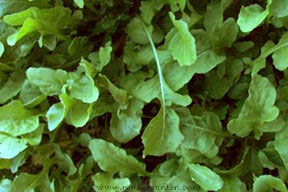
Add arugula to any summer salad. Photo courtesy Renee's Garden.

Add arugula to any summer salad. Photo courtesy Renee's Garden.

Pick the leaves while young. The flavor gets stronger as the leaves get older and larger. Home gardeners have the advantage with arugula because it is quite perishable. Arugula is used fresh or steamed in the way you might use spinach. Keep it close to the kitchen, so you can easily pick a few leaves for sandwich greens or add a bit to homemade pesto and salad dressings.

Arugula is slower to bolt than spinach. Add to pasta salads or homemade pesto.

Rich in nutrients, such as iron and vitamins A and C, and low in calories, your culinary imagination is its only limit in the kitchen. Because arugula is so versatile and comes in many varieties, don’t limit yourself to one variety or package of seed.

Arugula is said to have aphrodisiac powers. I’d like to know what you think about that.

Arugula is ideal for succession planting. Photo courtesy Renee's Garden.

Arugula is ideal for succession planting. Photo courtesy Renee's Garden.

The Great Sunflower Project

Herb gardeners know how important bees are to our gardens. One of every three bites of food we eat come from a plant pollinated by wild pollinators. Unfortunately many pollinators are declining. That’s what the Great Sunflower Project wants to change. 

05-10-2011-3

Grow sunflowers to attract butterflies, bees and finches. Photo by Patsy Bell Hobson

The Great Sunflower Project, a project that plans to unravel the mystery of the disappearing pollinators, pulls together data that you help them collect. With this data it will create a database to help understand what is happening to the bee pollinators and how our green spaces are connected. Sunflowers is an easy-to-grow plant that gives height to the herb garden and is wildy attractive to birds and bees.

Sign up and plant your sunflowers.
Watch your sunflower for 15 minutes: Write down how long it takes for the first five bees to arrive at your sunflower. After 15 minutes, you can stop. If you haven’t seen 5 bees by then, the Great Sunflower Project want to know!
• Enter your data online.

By watching and recording the bees at these sunflowers, you can help with the research the Great Sunflower Project is doing to understand the challenges that bees are facing. Grow annual ‘Lemon Queen’ sunflowers (Helianthus anus). I got mine from Renee’s Garden. ‘Lemon Queen’ is a lovely branching variety that is particularly attractive to bees. Other herbs that bees are attracted to include basils, borage, catmint, lavender and rosemary.

05-10-2011-2

Win ’Lemon Queen’ sunflower seeds and participate in the Great Sunflower Project. Photo by Rhonda Fleming hayes/Courtesy Flickr

Win ‘Lemon Queen’ sunflower seeds and participate in the Great Sunflower Project.
Photo by Rhonda Fleming hayes/Courtesy
Flickr

Seed Packet Giveaway

Renee’s Garden is giving away three packets of ‘Lemon Queen’ sunflowers to three lucky blog readers.

HOW TO ENTER

• Post a comment in the comments section below telling us why you grow, or why you want to grow, sunflowers.

• End date: June 1, 2011 (12:00 a.m. Central Time)

Good luck!


Rain Relief

For a short time, a very short time this morning, there was sunshine. After having such a long rainy spell, I grabbed the camera and ran went out to document the fact.

yellow iris

after the rain, a brilliant yellow iris opens up, a little.

Having survived the constant rain, this pretty thing wasn’t going to miss a minute of bloom time.

The rain beat off the petals on the dogwoods, lilacs and the last of the daffodils.

Already, the rain is back. The only plants that still have flowers, are the ones in bud that refused to bloom until this damaging rain stopped.

The flood gates are closed. Many folk are sand bagging hoping to save thier home from the continuing rains. Huge, hundred year old trees have topled over onto many homes.

lantana

little lantana blooms


rainy Broccoli

The broccoli is tired of rain

Even the herbs and vegetables are just sitting in the soggy ground, not growing.

Still, it was nice to see the sun and remember what it looked like.

rain and chives

The chives are thinking of blooming regardless.

The Napeta (cat mint) is just waiting for a few hours of golden light to really produce those lavender flowers that the bees love so much. This is a favorite, long blooming, no fuss perennial. Makes a great mounding ground vover.

cat mint

nepta, ot cat mint

Now for a bit of a cat nap on this rainy afternoon. (I love to sleep when it is raining.) Isn’t this Iris a lovely color?

Iris

These dark purple buds be come Lavender blooms.

More Thyme in the Garden

I have a lot more thyme than I used to. If you want more thyme, try these tips.

Thyme (Thymus vulgaris) is an aromatic herb valued as an ornamental and culinary herb. It has small lavender or pink flowers. Plant thyme in a rock garden or border for decoration; cultivate it for culinary seasoning. Thyme grows around 6 to 12 inches tall. It has a sprawling habit and can easily be increased from cuttings, crown division or seeds.

Strip the tiny leaves off the stem.

Strip tiny leaves from stem.
Photo by Patsy Bell Hobson

After its first year, cut thyme plants back each spring to renew them and keep them tidy. Plants prefer well-drained dry soil. Since it grows slowly, especially early in its life, weed-control is essential. It is a perennial in Zones 5 to 8.

Use fresh thyme with zucchini. Sauté any summer squash in a bit of butter and olive oil with onion, parsley, and thyme.

Read more: http://www.herbcompanion.com/in-the-herb-garden/garden-giveaway-thyme-seeds-spring-garden.aspx#ixzz1IjIlwh4u

Heirlooms in the Herb Garden

The word ‘heirloom’ harkens back to a nostalgic time—when life was sweeter, tomatoes were redder and folks actually used the word harken.

One of the best lemony herbs

Open-pollinated, or parent plants that are naturally pollinated, heirloom plants produce heirloom seed. The new generation of seeds will produce plants that are identical to its parent plants.

Many folks say that to be classified as an heirloom the cultivar has to be at least 50 or 100 years old. Others say before World War II ended. (The end of World War II marked the industrialization of agriculture and widespread hybrid cultivation.)

Heirloom plants have proven to be more heat tolerant, drought tolerant, insect resistant and have more vitamins and minerals. If they didn’t have any of these desirable characteristics, we wouldn’t grow them and soon they wouldn’t exist.

Mrs. Burns’ lemon basil (Ocimum basilicum citriodora ) is an heirloom (pre 1940) basil grown by Mrs. Burns in southwestern New Mexico. This lemon basil is taller and has larger leaves than other lemon basils. It also has an intense lemon flavor and fragrance.

Read more: http://www.herbcompanion.com/blogs/blog.aspx?blogid=2890&tag=Patsy Bell Hobson#ixzz1Ij5k9jME

What is soil temperature?

Wait until the soil warms to 70 degrees Fahrenheit (70°)  to plant peppers and tomatoes.

Plant tomatoes  when soil temperatures are above 60°. Temperatures below 50° are like a polar bear plunge to your lovely tomato plant.

soil thermometers

Warm season crops, like tomatoes and eggplant, need warm soil temperatures. If you plant tomatoes before the ground warms sufficiently they will not grow. The tomatoes will just stand in the soil and wait for warmer days.

Push a soil thermometer 4 inches into the soil where you plan to plant tomatoes.

Test the soil for 3 or 4 days. The soil temperature is the soil average. Measure the temperature in the mornings or before 10:00 a.m.

When the soil temperature is 40°, plant cool season crops kale.

50° – plant leeks and onions

60° – plant broccoli and cabbage

70° – tomatoes and basil

Measure the soil temp. and put the thermometer away.

You can plant the whole garden based on soil temperatures. Be sure to store the thermometer in a safe place. I only remind you because I “lost” my little thermometer last week, when I left it in the garden.

Ground-hugging Minus Thyme

Minus Thyme Thymus praecox articus ‘Minor’

Minus Thyme Thymus praecox articus 'Minor'

Minus Thyme is a perennial, hardy in zones 5-9. The evergreen, ground-hugging thyme is covered with pink flowers in late spring. One of the lowest growing thymes, it never exceeds 1”. Minus can take light foot traffic making it a good choice along pathyways and between stepping stones.

I bought a plug pack of 12, two years ago from Richters Herbs. The plants did so well, I ordered another plug pack last spring. Then, I divided the tiny thyme that I had planted between stepping stones. It is growing enthusiastically between stepping stones and is easily divided.

The spaces need weeding until the thyme fills in. This very slow process will take a couple more years to fill all the spaces between the stepping stones. I could speed the process by dividing the thyme clumps more often.

Minus Thyme with Cobra for size comparicon

Related Posts Plugin for WordPress, Blogger...