Thank you for the beauty

I love the Ozarks and I have no complaints about spending time in my hometown, Branson. My camera is filled with images of flowers, container gardens, and Ozarks landscapes.

So, it was a nice surprise this morning when some of my flowers came to me via email. Neighbor Bill sent photos of some of the blooms along with this note, ” Thank you for the beauty.”

It brought a tear of joy and surprise to my eye. So, I’m sharing a few of the photos with you.This is Summer Valentine. With pink blooms, a magenta eye and picotee edges. From All American Daylilies http://www.allamericandaylilies.com/

This double day lily was here when I moved in. It is beautiful and best planted in masses. The blooms don’t last long or repeat and I don’t know the name. It requires little attention, but when it blooms this bright orange day lily is not to be ignored.

The hummingbirds love this petite heirloom gladiolas.Bright red trimmed in a slim edge of silver, beautiful up close or tucked in a cutting garden. A favorite of mine, there is no such thing as too many Atom glads.
http://www.oldhousegardens.com is my gardening secret.

I have great neighbors.

Garden Bloggers Bloom Day June 2009

Dolly’s Garden


About 5 hours away from my garden, I decided to share Dolly’s Garden with you. I’m in Branson and I drive past Dolly Parton’s Dixie Stampede most every day. There is a giant butterfly made of flowers in the lawn.

Long story short. So, I drive up to the Dixie Stampede, loaded with two cameras. I can not wait to see what flowers they have used in this gorgeous floral landscape.

Maybe some dwarf gerbera daisies, little golden sunflowers, red cocks comb?

I had to laugh. The flowers are not real. And it makes sense to me. I think when you are driving by on highway 76, the important thing is big bold color and simple clear design. From the highway, the butterfly is gorgeous.

Up close, as you walk up to the box office, the flowers are real.Stella De Oro are h
ardy, permanent and easy to grow in most any soil, and they do standout like little golden trumpets. The green mound shaped plant is about 24 inches tall and wide, making it a compact landscaping plant that will look good all summer.

There are a lot of these sunny plants used in the landscapes throughout Branson. Stella De Oro offers a profusion of bright yellow blooms in early summer, then flowers repeatedly throughout the season. The golden blooms are are trumpet shaped and flowers reach about 2½ inches across.

All the window boxes are filled with beautiful artificial flowers. As I was snapping photos of the these fake flowers near the horse stalls, there was a grey horse that looked bored and sleepy, but the minute I started taking pictures, that grey mare perked right up. A show horse to be sure.

Dolly Parton’s Dixie Stampede Dinner & Show
1525 W Hwy 76, PO Box 6850
Branson, MO 65615-6850
Toll-Free: (800) 520-5544
Phone: (417) 336-3000
Fax: (417) 339-4350
Website: http://www.dixiestampede.com
E-Mail: bransonreservations@dixiestampede.com


The grey mare became lively and alert when the cameras started clicking. She did not know I was only taking photos of the colorful but fake flowers.

Ticks and Chiggers

Chicks and tiggers, giv’em the brush

I used the phrase chicks and tiggers instead of ticks and chiggers when I was young just to aggravate my brother. Chiggers are not bugs or insects. Chiggers are the juvenile (or larval) form of tiny mites, the Trombiculidae. Mites are arachnids, like spiders, and are related to ticks. Chiggers may be even more aggravating to gardeners than I was to my little brother using this tang tungler.

It is a myth that nail polish, bleach, alcohol, turpentine or salt water will rid you of ticks or chiggers. Chigger mites are unique among the many mite families, only the larval stage feeds on vertebrate animals; chiggers dine on us only in their juvenile (or larval) stage. As adults, they become vegetarians that live on the soil.

My eye sight has never been good enough to the tiny red chiggers. I usually discover them after they have settled in for dinner. I am the main course. Chiggers are tiny. But you can brush them off. They are looking for tender, thin skin such as where the skin wrinkles and folds. Sadly, the longer I live, the more ideal dining area I provide for ticks and chiggers.

As if chiggers aren’t annoying enough, this illustration and the following paragraph are right from the Ohio State University Extension Fact Sheet HYG-2100-98

Bites

Chigger larvae do not burrow into the skin, nor suck blood. They pierce the skin and inject into the host a salivary secretion containing powerful, digestive enzymes that break down skin cells that are ingested (tissues become liquefied and sucked up). Also, this digestive fluid causes surrounding tissues to harden, forming a straw-like feeding tube of hardened flesh (stylostome) from which further, partially-digested skin cells may be sucked out. After a larva is fully fed in four days, it drops from the host, leaving a red welt with a white, hard central area on the skin that itches severely and may later develop into dermatitis. Any welts, swelling, itching, or fever will usually develop three to six hours after exposure and may continue a week or longer. If nothing is done to relieve itching, symptoms may continue a week or more. Scratching a bite may break the skin, resulting in secondary infections.

disgusting, huh?

The best way to avoid them is to take a soapy shower after you have been stamping around outdoors. Though they are young, chiggers are vulnerable to temperatures. Chiggers are most active in the afternoons, and when ground temperature is between 77 and 86 degrees. Researchers have also found that chiggers actively avoid objects hotter than 99 degrees. Rocks that have been baking in the sun are usually free of chiggers, and make a safe place to sit when you are in a chigger-infested area. Chiggers become completely inactive when temperatures fall below 60 degrees; temperature below 42 degrees will kill the chigger species that bite us.

Excellent information about preventing and caring for tick and chigger bites is on the Missouri Department Of Conservation Web site: If you are in an area that probably has chiggers, the best thing to do is take a soapy shower as soon a possible. A shower or bath is the best defense. If this at is not possible, give them the brush. A brisk brushing off of your arms and legs will crush or knock them off before they c an attach. State health department officials have documented a 300 percent increase in tick-borne disease in Missouri since 2003. Good information about ticks is also at the Missouri Department of Conservation website.

This tick illustration using the dime for comparison is from the CDC.

GMO Beet Roots Busted

GMO seed means you no longer have a choice.


From:
http://nicholsgardennursery.wordpress.com/2009/05/31/gmo-beet-roots-busted/

My friend and fellow writer Rose Marie Nichols McGee, has this story on her blog,
The Gardener’s Pantry.

Tomatoes at a Baker Creek festival.

GMO Beet Roots Busted

The presence of viable GMO sugarbeet roots in recycled potting soil is the lead article in today’s Corvallis Gazette Times/Albany Democrat Herald. The beets were identified because they bore numbered tags. I’m not going to repeat or paraphrase this article which is an excellent example of hometown journalism and why we need our newspapers. For the rest of this article go to her blog.

http://nicholsgardennursery.wordpress.com/2009/05/31/gmo-beet-roots-busted/

To the credit of a local newspaper reporter, we know about this.

Roundup Ready sugarbeets — a patented variety engineered by Monsanto to tolerate the company’s widely used Roundup herbicide — have turned up in a soil mixture being sold to gardeners at a Corvallis landscaping supply business.

Battle over beets can be reached at bennett.hall@lee.net or 758-9529.

I am passing on this information because it’s about a better, safer food supply, and the fight to resist gene-altered Frankenfood and the companies that support it.

I only know what GMO* means because of Jere Gettle of Baker Creek Heirloom Seed Company.

His seed company offers open-pollinated seeds: pure, natural and non-GMO, from 70 countries, including many that he collected. Jere Gettle started Baker Creeks Seeds in 1998 as a way to preserve rare seeds.

Emily and Jeremiah Gettle

Being one that can not pass up a bargain, let me just say: at Baker Creek, they are offering
FREE shipping on all online orders, through June 15!

* GMO is Genetically Modified Organisms (GMO) or gene-altered food.

The store in Bakersville, home of Rare Seeds.com


Grateful Gardener

You’ve been hearing us talk about Spring Fling 2009 in Chicago.

Garden Bloggers Bloom Time


Webster says a Busmans Holiday is a holiday spent in following or observing the practice of one’s usual occupation.

Gardeners and garden bloggers from across the country gathered at their second annual gathering, the Spring Fling for Garden Bloggers. This year, we were in Chicago. The best part for me is to actually meet these people that I have come to know and count as friends.

Our sponsors have been generous, many are lawn/farm/garden suppliers that we, as passionate gardeners, have known for years. For example, when I moved to a home with three acres, one of the very first things I bought was a pony Troy Built Tiller.

I used that tiller for years, and even loaned it out to a lot of neighbors. That Troy Built tiller taught me one
thing. Investing in good tools is well worth the money. Buying good garden tools makes a gardeners life easier. You don’t have to worry about tools breaking or failing when you are just starting a gardening project.

So when the garden bloggers gathered, some of the sponsors were old friends of ours. Troy built came by to say welcome and thank you. Troy Built would be singing to the choir to tell this group of gardeners about their quality products. I know their garden equipment is great. I want to thank them for their sponsorship. I didn’t win the Troy Built prize, still I’ve had years of never-fail use from their equipment.

LEHR is a new product name to me. LEHR is dedicated to a cleaner planet through environmentally friendly technology. Immediately, I know I am going to like this company.

I was lucky enough to win their propane powered eco trimmer. LEHR is committed to their customers, their neighborhoods and the environment. Everything that carries the LEHR name is designed and developed to be cleaner, greener, and more user friendly than comparable products on the market.

On my blog, Oh Grow Up!, I’ll tell you all about it. We have a one acre lot, which loosely translated means, hours of trim work every week spring to fall. A few of the other sponsors included Renees Garden, Ethel Gloves , Sunset.com and Garden Shoes Online.

We concluded the bloggers gathering with a visit to Garfield Park Conservatory. Jens Jensen (1860-1951), the architect, designed interior rooms to look like outdoor landscapes. Jensen placed plants directly in the ground and framed views by keeping the center of each room open, with a fountain or a naturalistic pond as the centerpiece.

Gardening is a lot of work. It’s our job. Our hobby, our pastime, and what we do to relax.

Guzmania ‘Sir Albert’ Bromeliad

Miss Mary Mary and Bitsy Tie For First Blooms Of 2009

First day lilies of the season.


Bitsy 2002 Earliest Blooming Variety;
Blooms 85-275 Days Per Year.

Posted by Picasa
Miss Mary Mary 2005 All-American title is granted only to those rare daylily varieties that have demonstrated superior performance in dozens of criteria across at least five USDA hardiness zones. The AADSC All-AmericanDaylily Award differs from others in that its results are based on rigorous scientific methodology.

From our friends at
All-American Daylilies

No Skinny Beans or Eggplant Parmesan

Fresh Beans Snap

All the gardeners are out gardening. So, for those of you who don’t garden but like to eat, this blog is for you. If you are not blessed with a neighbor who grows too much and likes to share, then consider visiting the Farmers Markets.

In June, look for apricots, basil, beets, blueberries, broccoli, cabbage, cauliflower, carrots, fennel, cut flowers, greens, leeks, lettuce, onions, parsley, peaches, peppers, potatoes, raspberries, rhubarb, shallots, snap beans, spinach, summer squash, strawberries, and turnips.

By snap beans, I mean what most folks refer to as green beans. Snap beans, string beans, or green beans are not always green. Look for white, purple, and yellow varieties at the market. Try the flat Italian type, the petite French variety, or, Chinese long beans. There are string beans and stringless, yellow wax, lima, butter beans and fresh green soybeans.

The traditional fresh green beans you find at the market are more flavorful than the weeks old “fresh” green beans found in some stores. To check for freshness, snap a bean. It should break crisply and not bend. Fresh green beans are available for a longer season than most produce because more than one crop can be planted in a growing season.


If you are lucky enough to find fresh beans that are not the usual grocery store type limp grey/green bean, snap them up. Variety is one of the advantages of local Farmers Markets.

This is where the photo of the green beans
would have been if somebody hadn’t eaten them all.

French Cuisine – Rabbit Food

Since the rabbits in my neighborhood have developed a taste for haricots vert, I’ll be looking for them at the farmers’ market. Haricots vert [ah-ree-koh VEHR] is French for “green bean.” If you are not brave enough to try the pronunciation in public, just ask the farmer for those skinny French green beans. These tiny tender green beans are great served cold and lightly marinated. The neighbor next door makes a pickled green bean called Dilly Beans.

I always steam more than I think the two of us can eat for dinner in the hope that there will be leftovers for my lunch. It rarely happens. My husband and the rabbits have this in common: they will eat every haricot vert in site. I planned to grow a bumper crop of the skinny French green beans, but evidently word got out among the wildlife population. Rabbits eat what I grow and my sweet husband eats what I buy at the market. There is always a haricots vert shortage at my house.

Botany Vs. Gardening

Looks suspiciously like Eggplant Parmesan.
Weeds Parmesan

My sweetie is a botanist. I am just a simple gardener. The botanist, told me that eggplant is not on the food chain. If it is not on the food chain, I wonder why the Burpee and Baker Creek sell eggplant seed with all the other vegetable seed.

Still, even the clerk at the Garden Center knew this. When I went through check-out, I made the enlightened comment that eggplant wasn’t considered part of the food chain by some gardeners and botanists. “I know,” she said. “I agree. You won’t find eggplant anywhere near my garden.” Maybe the Garden Center doesn’t know it has mislabeled all of the eggplants as vegetables.

As Sweetie explains it, eggplants aren’t plants, they are weeds really, and not meant to be food. I planted eggplant in the garden anyway. Later this summer, we will try a new recipe: Weeds Parmesan. It’s a favorite of mine that tastes remarkably like Eggplant Parmesan.

Earthworms V. Rob and Hood

I’ve Got Worms!

Agriculture and Natural Resources, University of California posts this rather philosophical reflection:

The humble earthworm: memento mori extraordinaire: “Remember that thou shalt die.” The Conqueror Worm, devourer of prince and peasant. Metaphor for the frailty of the flesh, subverter of monuments, leveler of empires. Emblem of the vanity, the evanescence, and the end of all human endeavor. And yet, paradoxically, this earthworm, this great destroyer, is also a great builder – a builder of fertile topsoil, itself the sustainer of all civilization.

Sounds a little Shakespearean, doesn’t it?
I bought 50 encapsulated earthworm cocoons from Gardens Alive!

They arrived in May, a good time for me, because the soul had been weeded and was ready for planting. My goal for the red worms is they will grow
forth and multiply to a sufficient level to maintain a healthy soil. I planted these ready-to-hatch egg cocoons just like garden seeds, only deeper. Earthworms are living composters.

As I start out with a new organic vegetable garden, I don’t have a lot of earthworms in the raised beds because I made the garden soil myself. The surrounding lawn has plenty of earth worms. (Some of the worms are so big, they startle me when we encounter each other. At first, I think they are garden snakes.)

For my vegetable gardens, I was aiming for a lighter soil than the clumpy clay of southeast Missouri. The raised beds warmed earlier than the surrounding grounds and I was able to work the soil in the raised beds sooner this spring. The Lumbricus rubellus (litter worm or red wriggler) eggs should be hatching now and in the weeks to come.


The next day after I planted the encapsulated eggs, a squirrel dug up a couple of egg cocoons, but left most of the 50 undisturbed. So, I replanted the ones the squirrel dug up. I don’t know if they will hatch or not. These aren’t the same red worms as are in my vermicomposter. I’ll tell you about the garbage eating worms another day.

So far the only threat to the worm population is Rob and Hood, the odd couple of the Robin world that follow me every where waiting for me to dig up or otherwise disturb the soil, providing them a buffet meal. Some times I cover up the worms I unearth in hopes the lazy team of Rob and Hood will not turn the worm into lunch.

Earthworm castings turn garden soil into black gold, speeding the development of nutrient-dense, moisture-dispersing humus. Gardens Alive! recommends one egg capsule or cocoon for each square foot of garden.

I admit I wasn’t the scientific about the cocoon planting. But I did note which beds received the eggs. Oh, and I also poked a couple of cocoon eggs in the straw bales.

The soil is in pretty good shape from the look and feel of it. This growing season will be the test of the soil. In the fall, I’ll have a soil test from the UM Extension. University Extension also demonstrates How to Build a Compost Bin, which shows several methods of composting.

My goal is to increase the worm population in the raised beds. The worms will aerate the soil by tunneling through the ground, leaving nitrogen-rich castings to feed the plants.

My hope is that the earth worms can populate the garden faster than Rob and Hood can eat.

May Bloom Day

Ahh, yes, Bloom Day. I’ve been so preoccupied with my gardens that I’ve started talking to myself. “WOW! When they said ‘May be invasive,’ they really meant it!” and “Why did I plant That?


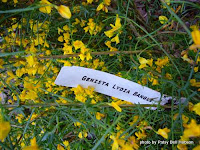
Genista lydia Bangle is a nearly leafless plant with bright green stems when it is not blooming tiny snapdragon-like bright yellow flowers.
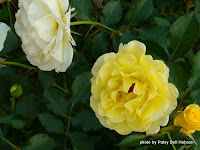
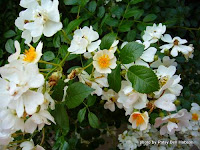
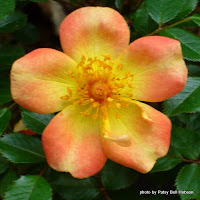
To my greatest delight the roses are so beautiful this spring. If I could tell you more about them, I would recommend them. But I am one of those folks that believes I will always remember. And even if I did write it down, I can’t remember where I put that piece of paper so I would never for get where it is. I wanted to share this yellow rose because it starts out as a bright yellow bud and gets lighter as it blooms. These two roses, the yellow and the apricot, are the most fragrant roses.
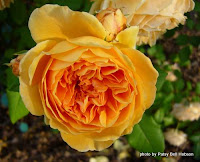
Rosa Crown Princess Margareta
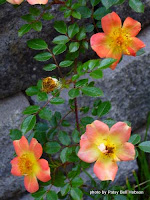
I lov
e these little wild looking roses. They put on a big bloom of enthusiasm, then continue occasionally to bloom all summer. When it gets cool in the fall, they start to get excited and bloom heavily again. Even a light frost will not deter them. I’ve had blooms on the Thanksgiving table from these little roses.

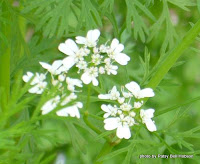
The chive flowers are still hanging on. That short-lived cilantro that reseeded itself, is about to bolt. I’ll plant some more so I will always have it for Mexican dishes. (Ha! As if I had a kitchen to cook in.) The chives are supervising those insecure and clingy spring peas that may or may not reach maturity. A mild spring can turn into a ferocious summer in a day here in Missouri. I love the sage flowers, the bees love it too.
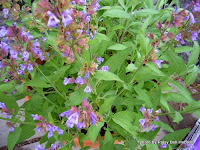
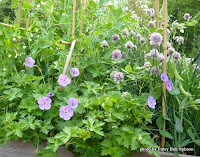
Sage, cilantro, geraniums replacing the lavender chives near the spring peas.

In my garden, sage is grown both a culinary herb and a perennial flower. Sage blooms in the most delicate lavender shade. It’s a must-have herb in the garden with long lasting spiky blooms and an essential ingredient in corn bread dressing or grilled pork chops.
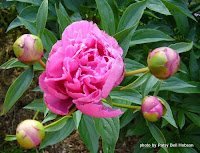

Peonies are blooming. They always remind me of my grandmother and Decoration Day, as she called Memorial day. I would cut a trunk full of peonies, and bring them down to her house Memorial Day weekend. We put the flowers if fruit jars and decorated of family grave sites with the peonies. Some were here when I moved in. Badly overgrown and neglected. Little by little they are looking better. A hardy serving of compost, some bone meal and plenty of mulch has improved their bloom number only slightly. “But they just LOOK better, I keep telling myself.” The bright pink color is an older variety – who knows the variety? The only acceptable solution is to love ‘em and leave ‘em wh
ere they are, or replace them with larger and newer varieties, which will take a couple of years to get healthy, well rooted plants to make them selves at home. Peonies always look better when they are weeded and cared for. I imagine, if they are left to grow, they may outlive me.

This tiny yellow flower is arugula that has gone to seed.

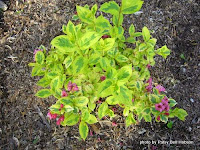
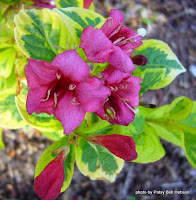
Weigela – VariegatedWeigela florida ‘Variegata’ I grow it for the foliage, the flowers are a bonus.
The last of the iris are still beautiful.


An old fashioned Aquilegia (Columbine).

Marigolds
In Summary,

Three things:

1. Buy a Gardener’s Journal – A Ten Year Chronicle of Your Garden, like Lee Valley Tools http://ow.ly/71Bh It’s so big and heavy, I can’t loose it. Now, when I buy a plant, I write down the name, in this book. NOW PLEASE!

2. If anyone at the nursery ever hands you a cute little green plant in a 2 ½ in pot and the label reads “may be invasive.” Smile. Return the plant. Take a step back, turn, and run for your life. Lock your car doors, and check to make sure no one has ‘gifted’ you that cute green plant in a 2 ½ in pot.

3. When you are leaving comments on other garden bloggers bloom day blogs, NEVER, NEVER mention their big bloomers.

And finally, something to share from a southern Missouri gardener:

You Might be a Redneck Gardener If:

You mow your lawn and find a wheelbarrow.
A half moon reminds you of your fat husband pulling weeds.
You think a chain saw is a musical instrument.
You move your refrigerator and the grass underneath it is yellow.
Kudzu covers your arbor.
You don’t water your front yard rather than mow it.
You know how many bags of fertilizer your car can hold.
You’ve ever cleaned your house with a leaf blower.
You empty the trash when you have enough to fill up the pickup.
You can amuse yourself for more that an hour with a hose.
You’ve been cited for reckless driving on a riding lawn mower.
You move your weed-eater to take a bath.
– Culled and Revised by Mike Garofalo http://www.gardendigest.com/humor.htm

Straw Bale Garden

Vegetables By the Bale

    Example April 3,H 61,L55, p41. =
    Key:date:April 3,Te
    mperature High 61,Temperature Low 55, precipitation .41″

Rose Marie’s blog is The Gardener’s Pantry.
Patsy Bell’s blog is Oh Grow Up!

I decided to try straw bale gardening after reading about it by Rose Marie Nichols, of the family operated Nichols Garden Nursery and member of Garden Writers Association.

We’ve agreed to keep each other up to date on our gardens this year. Nichols Garden Nursery is in Albany, Oregon in the Willamette Valley and my garden is in Cape Girardeau, Missouri, in southeast Missouri hugging the Mississippi River (37°18 33″N 89°32 47″W elevation: 410 ft.)

For The Oregonian, Anne Jaeger and Rose Marie have a quickie video demo of how to do plant a straw bale. A more detailed guide is on the Nichols web page, Nichols Garden Nursery.

No point reinventing the wheel so, I won’t repeat every thing Rose Marie wrote about straw bale culture. I’m going to keep a journal on the blog and include photos.

I finally started my Garden Bales. There is not much to see. In front of the five bales on the south are alpine strawberries (right as you face the bales looking east).
In front of the bales on the north or left side are marigolds. I poked a few nasturtium seed in the corners of the bales. We will see how that grows. Nasturtiums have not been a good choice in the past. I attribute their failure to my neglect.

  • March 2009. Straw bales delivered. We are still getting freezing weather in MO. I’ve arranged the bales and watered them. The frequent freezes and cold rains are dashing hopes of an early start in the garden this year.
  • April 3, Hi 61, Lo55,precip 4. My bales are not baled with synthetic twine, as Rose Marie suggested. I was happy to get 10 bales of good straw delivered. I soaked the straw with water. For the next couple of weeks the starlings feasted on the straw seeds, some birds carried off straw for their nests. Still, there was plenty seed left to sprout into a green carpet atop the bales.
on the right, Baby Pak Choi seedlings. On the left leek seedlings.
  • May 8. I started 5 of the straw bales garden project by spreading the bales with bags of potting soil and compost to equal 2 or 3 inches of soil. The first thing I planted was some baby pak choi plants that I thinned from the raised bed garden, a few onions, leeks and scallions that I also planted in the raised beds. I also planted some pepper plant seedlings that are just an inch or two tall, and a few zucchini seed. Then I sprinkled in some mesclun (mixed lettuces) seed across the top of the rest of the bale. The leeks and onions are not a good idea, but I had extra seedling and no place to put them. So, that’s just an experiment. Perhaps I will transplant them again into the raised beds when I have a little more room, after I pick the peas.

The lettuces will be thinned and harvested to make room for the peppers and squash as they grow. The zucchini, by the way, is a Nichols variety called Aristocrat Zucchini , a hybrid, a dark green upright bush type.

  • May 9. We pounded in eight foot long 1 x 2 stakes to support tomato plants. It was threatening to storm and this is just before the big wind and rain storm that left many folks without electricity for four days.

“Why are you pounding in those stakes?” asked the teen next door. “To keep the bales from blowing away?”

Insects found the pak choi on the bales right away. Insects are not bothering the pak choi that was planted from seed in the raised bed beside the garden peas and chives.

  • May 10, hi 71, lo53, precip .25. Sprayed some insecticidal soap on the pak choi. The pak choi is a cool season crop and often bolts in a sudden hot spell. So, this is truly an experiment. If it stays cool, we may have some great stir fries this spring. I’ll share a recipe and show you how I cook them, if the baby pak choi do mature.
  • May 12, hi74, lo49, precip 0. One of my biggest challenges is to remind myself that not everybody knows or cares about gardening. With record garden seed sales, and even Michelle Obama planting a garden on the White House Lawn, I just thought everybody must be into gardening. So when a neighbor walked by the garden and asked what those purple flowers are in the raised bed, I thought she was kidding. (They are chives, by the way.) And then, the next day, another neighbor came by and asked,

“Whats with all those hay bales in your yard?,” so I explained all about straw bale gardening. The neighbors have taken notice that something different is going on.

Just a couple of doors down, a teacher with the cutest three year old son came by. The little boy mostly says,

“WHATS THAT?” He does not like many vegetables. He was a little curious about the garden, but his mom doesn’t care for a lot of vegetables either, so I should not be surprised he doesn’t know a pea plant from a potato. I think it’s important that kids know where their food comes from, so I’m not giving up. Perhaps when those sugar snap peas or sweet cherry tomatoes are rich and ripe, I may be able to tempt him in to tasting one.

  • Albany, Oregon: elevation:200 ft (for you gps fans, coordinates are 44°37 49″N 123°5 46″W)
  • Cape Girardeau, Missouri: elevation: 410 ft (37°18 33″N 89°32 47″W)

  • According to Yahoo maps,
    we live a driving distance of 2,094.61 miles apart or, a driving time of 31 hrs 8 minutes.

Related Posts Plugin for WordPress, Blogger...