Category Archives: My Gardens

What works and doesn’t work in the home garden. Great garden ideas, practices, blooms and growing suggestions

Tiny, Tasty Alpine Strawberries

Ripe berries are sweet as candy

Wild Strawberries and Alpine Strawberries are hardy, disease resistant and perfect for a low border or edging plant. They are also a great ground cover. Some folks include them in grass-free lawns. I’ve tried a couple of times to start wild strawberries from seed and failed. When I had the opportunity to start new gardens in a new home, I went a little overboard with these tiny berries.

Sweet fruits are grown from seed

I ordered “Mignonette” French strawberry seed from Renee’s Garden Seed and had great success using the AeroGarden. The plants, once started, are easy to grow. They are compact perennial Alpine strawberry plants producing sweet, pointed fruits from early spring to the last frost.

I notice that Renee’s has an article about these itty bitty berries on her web page. This is where I got the idea to use these strawberries as an edging plant. Renee’s is a reliable and prompt source to order seed. May or June is not too late to start plants from seed (and you will get prompt seed delivery here.)

That same year, I bought a Fragaria vesca “Ruege” plug pack of 12 plants from Richter’s. These sweet and tangy berries are just a little smaller in size of the wild ones on compact, runnerless plants but they do multiply and should be thinned every few years. Bears fruit from May til frost. Richter’s has the best selection of culinary and medicinal herb plants that I have found.

Both plants have multiplied rapidly.This spring, they started blooming in March. A late freeze only slows them down but they soon begin setting bloom again.

I think that those monster sized rugged and tasteless berries at the grocery store turned me away from normal strawberries. The tiny Alpine fruits taste like strawberry candy in comparison.

Tiny white blooms continue all summer

The first year, it was a contest to see who would get to eat these mini delicacies, me or the birds. There are so many of them and the season is so long, that now the birds and I have agreed to share the abundant harvest.

A third variety of strawberry grows in my gardens. French‘Mara des Bois’ from White Flower Farm.

‘Mara des Bois’ lives in hanging baskets on the patio and are just starting to produce this year. Last summer I had one or two berries and a winged predator or possibly my beloved ate the rest. There were not a lot of berries because the plants were busy trying to escape their confinement by sending runners over the edges of the hanging baskets. The berries are twice the size of the Alpine berries, but that still means a very small berry compared to what we find at the grocery. These hardy little plants over wintered in a hanging basket sitting on the patio all winter.

Fraises des bois is a French word for strawberries of the woods. The strawberries are also known by other names including: Fragaria vesca, Alpine Strawberry, Wild Strawberry, Woodland Strawberry, American Strawberry, European Strawberry, fraises des bois, and fraisier des bois. Call them what you will, these itty bitty berries a too fragile for transport. The little ones fetch premium prices at the market.

The tiny berries are beautiful garnish on a desert plate. It is said that tea made from the leaves will stimulate the appetite. They grow as an evergreen edging along the sidewalk in the potager, making for easy picking as I walk by.

Try balsamic vinegar with strawberries

Garden Bloggers Bloom Day May 2010

chive and sage blooms

Most herb flowers are small and unremarkable, but I look forward to these lavender colored chive and sage blooms every spring. They are edible, but I prefer to gather a kitchen bouquet so I can enjoy the flowers even longer.

Kitchen bouquets make herb leaves close and easy to use for cooking.

Flowers in the kitchen

Chive flowers will turn this white wine vinegar pink

More lavendar colored flowers

clematis “President” is a homeless plant I have yet to move to a permanent home. It has faithfully lived in this plastic pot for over a year.

( It takes just a little imagination to view the next blooms which are in my camera but not in my possession right now.)

Strawberries

Roses

Astillbe

Daylilies

Columbine

Carol, garden blogger at May Dreams Gardens started the Bloom Day tradition Garden bloggers Bloom Day May 2010.

Seed Sales

Late Spring Seed Spree for 2010

Early peas will be replaced by green beens.

After peas are harvested, snap bean will follow

Most seed companies have reduced prices to tempt you into buying more seeds about this time every year. It is a good time to see where you can fill the empty spaces in your garden and try some succession planting to keep your garden growing until late fall. These are a few of the seed companies that caught my eye.


Renee’s Garden Seeds says, “Planting season is here, and we’re offering a Spring Fling Discount of 15% off your next order.
Enter DSC410 in the “coupon code” box on the checkout page. Good on or before May 2, 2010. Shop for seed to grow cool season crops.


Small enough to eat grilled or stuffed for appetizers or on a veggie tray

Compacts pants are a good choice for containers.

Gurney Seed and Nursery Co is having a clearance sale. They have a Special Offer: Save $20.00 When You Buy Product Totaling $40.00 or More. Limit One Offer Per Customer. I bought a couple of thornless blackberry vines. I’ve always had good luck ordering asparagus and fruit trees from Gurney’s.

Johnny’s Selected Seed, “Take 20% off selected varieties (below) while they last.save 20 percent on potatoes Use offer code 10-1070 when checking out to get your discount.” They are offering Yukon Gold, Dark Red Norland, Red Gold and Superior. All good home garden choices. Also take advantage of the bumper seed crop with reduced prices on select seed varieties.

Seeds of Change will give you 10% off everything when you become a fan on Facebook. Use offer code: FACEBOOK at checkout.


Even Home Depot has Buy-One-Get-One seed packets right now.

Squash are heavy producers. Plant only a few of each kind.

Most all the spring crops are in the ground. If yours are not, you still have time for salads and spring greens. Now is a good time to look over your remaining seed and plan for the space that will be available as you harvest spring crops.

Garden Bloggers Bloom Day April 2010

Everyone who gardens in zone 6, has something growing or in bloom by now. My favorite small native trees, the redbuds and dogwoods are putting on quite a show.

Yellow Darwin tulips

tall white tulips have lasted longer than the reds and yellows.

Most of my tulips are in their last days. But these yellow Darwin tulips are stong and tall and have outlasted all the other tulips in the front garden. On the patio are some tall white tulips that are  holding their shape and lasting days.

taken overhead some white tulips are tall and beautifully shaped

taken overhead white tulips are tall and beautifully shaped

There are more of these Bakeri tulips this year than I planted last year.

Late bloomers came on strong after most of the tulips were gone.

There are a few species tulips that were late bloomers. Showy lilac-pink flowers with deep yellow centers  – I think they are late so they could have the bed to themselves.

The tag says “Speedwell.”

Also known as Veronica ‘Waterperry Blue’, this little groundcover likes it here in southeast Missouri and takes care of it’s self. It came in two little starter containers about two summers ago. It grows to 2″ tall and is adorned with a soft, light blue flower in masses. This is but one of many veronicas that can be used as ground cover. It will spread and flourish in your flower bed or work perfectly between stepping stones or in a rock garden.

There are dozens of Veronica varieties

Veronicas are deciduous, meaning they’ll drop their leaves in the fall. The daffodils came up right through the Speedwell and next the poppies will have no trouble poping up through the creeping veronica or Speedwell. I know a lot about this Speedwell because I remember where I got it and the tag is stll in the plant. The Speedwell is from STEPABLES.®.  Frances Hopkins the founder and CEO says STEPABLES® are earth-friendly, easy-to-maintain perennials that take foot traffic. Happy anniversary to STEPABLES,®.  2010 is Stepables 10th year in business. Consider these plants for a lawn alternative or to fill between stepping stone paths.

Just about 5" tall

These tiny Iris are look like a miniature version of the familiar ones.

This time last year I showed you my tiny lonely, native Iris cristata ‘Tennessee White’ (Tennessee White Woods Iris) They are a perfect white iris, just about 5” tall. This year we have couple of dozen iris growing beside an old tree stump.

Fruit trees escaped late freezes. Pink peach blossom and white apple blossoms.

trial peach tree is in a container and overwintered well.
These apple trees are two and three years old. We may have fruit for the first time this year.

This amazing tulip is exactly half yellow and half red.

I’ve never seen a tulip like this and I didn’t see any like this last year, which was their first spring.

Long lasting, standing up in a day of some rough winds

A tulip that could have been missed in a sea of red and yellow tulips.

frost damaged but still creating a bright spot in the landscape.

Autumn Cheer’s lovely medium pink blooms add a splash of spirit to any landscape. Encore’s Autumn Cheer is a small azalea with single pink blooms. I have several Azaleas, but this little one is a standout.

New! Chinese Chives Are the devil in disguise

Really, these are garlic chives.

Here is what Renee has to say about Chinese chives:
“One of my favorite fresh herbs, Chinese chives, combines the flavor of garlic and the sweet oniony taste of chives in a perfect marriage. The 10 to 12 inch long, strappy flat leaves are scrumptious whenever you want a hint of garlic flavor without the fuss! Use fresh as they lose their savor when cooked. I snip them into ½ inch pieces to sprinkle over fresh salads or on top of most steamed vegetables or a plate of juicy sliced tomatoes. They are wonderful in potato or pasta salads, with scrambled eggs, or even deep fried to finish a rice dish. When your plants begin to bloom with pretty white flowers – break up and sprinkle the individual florets over salads for an ornamental and edible flower garnish.”

And I agree. They are everything Renee says. But there is more:

This is my story: After a lecture on herbs, the speaker said she had free samples of garlic chives for everyone. She had enough clumps to give to each of the 30 young and foolish beginning herb gardeners. She dug up these 30 fist fulls of garlic chives and wrapped them in plain newspaper to keep from getting our cars messy, she said. As I look back on this herbal exchange, I now believe the newspaper was meant to cover up the garlic chives. Sort of like the infamous plain brown wrapper. That way neighbors could not see what we were bringing into the neighborhoods. There would be no screaming or shouting or alerting the homeowners association plant police. And it also provided a cover up so no one would know she was herb trafficking in garlic chives.

To say that garlic chives are invasive, is an underestimate and should be punishable by law when people do not offer full dislosur. The plain truth is Chinese Chives are out to take over the world, one herb garden at a time.

In fact, this is how I started out on the herb speaker’s bureau. I volunteer to speak to herb gardener wannabes. After the lecture, I pass out free samples of Chinese Chives to all the attendees and their friends and families too.

Renee’s Garden

http://twitter.com/reneesgarden

Tigger, the melon

This is Tigger, the melon. I mention it now because I am getting a lot of comments on Facebook about it.

I’ve never grown this midget melon before, but the seeds were free. So I am sharing with five other gardeners. I can do this because there are more seed than the 25 seeds the package promised.

Each melon is a single serving

Here is what I know.  I’ve seen the seed advertised in Baker Creek Heirloom Seed Company and Territorial Seed Company.

The plants are heavy producers of baseball sized, white fleshed fruit. What caught my attention is these fragrant fruits are only about a pound when mature. That’s about all the cantaloupe-type fruit I want. Watermelons, pumpkins and cantaloupe rarely make an appearance in my garden because the sprawling plants take up a lot of garden space.

Because they are so small, I may try to grow them on a trellis. The seed packet says 80 days, Tigger will ripen about the same time the garden explodes with tomatoes.

Better Than Rocks

As gardener frustrated by poorly drained and weighty rock-filled containers, I discovered the best back-saving container garden product on the market. If your potted plants are turning yellow from the bottom or wilting even though they are getting enough water the cause may be insufficient drainage and aeration.

Better Than Rocks produces healthier plants, lighter containers, drains excess water away from plants and keeps the soil in the planter. BTR is inexpensive, recycled and reusable. If it is not in your garden center yet, order it online. www.betterthanrocks.com

This product, like good tools, are a one time purchase. The Better than Rocks product I bought three years ago is the same product I will use this spring. What I like about this product is that you buy it one time then use it and reuse it forever.

Line the bottom of containers with Better Than Rocks. Smaller pots require one layer for good water drainage and to keep your potting soil from washing away. Big, deep pots can handle several layers of Better Than Rocks to lighten up the container and reduce the amount of pricey potting soil. Better Than Rocks can stay in the pot as long as you like. If you empty the containers at the end of the season, hose off the recycled plastic material and BTR is ready to reuse.

Sarah B. Atkins, who discovered the material, has used and reused the same Better Than Rocks product in various containers for ten years. What could be better than a garden product so good that you never have to buy it again?

Better Than Rocks How It Works

Better Than Rocks Where to Buy

Bloom Day September 2009

Welcome to Garden Bloggers’ Bloom Day in Cape Girardeau, MO USA
This is the last of the hardy standby rudbeckia blooming.

This is a gifted rose from the storybook series. It’s a prolific bloomer, no fragrance, but the color stands out from a distance. I never saw these on the market, too bad because I would buy more. They are faithful bloomers, even gracing the Thanksgiving table last year.

I still have a lot of food crops blooming. “They won’t have time to make”, as grandma used to say.

This tasty English cucumber is still producing long skinny, thin-skinned. cucumbers.
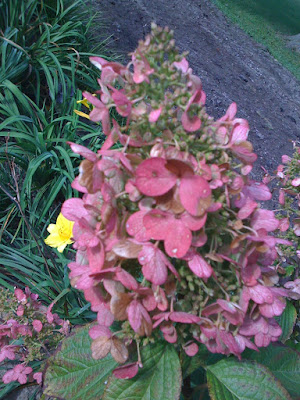
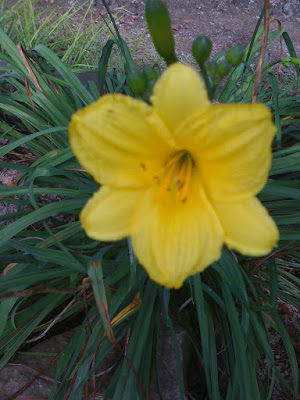
Pinky WinkyHardy Hydrangea or Hydrangea paniculata is growing in a couple of places in my yard, The one that gets more sun does the best. Hiding behind thee hardy hydrangea, is Buttered Popcorn day lily, Hemerocallis Buttered Popcorn. It’s a repeat bloomer and the brilliant yellow blooms always get noticed.

About now, I should tell you that I’m using the camera/phone, and I have no excuse for the photo quality, except I can’t keep it steady enough for good photos.
Crown Princess Margareta, a David Austin Rose. Once it is cut, the heavy blooms tend to droop, so is it not a good choice for bouquets. Still it is so fragrant and lovely, it’s hard not to bring a few cut flowers indoors.

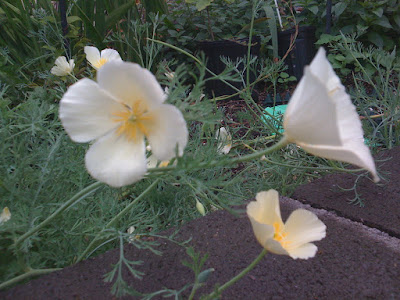
These creamy poppies were a garden surprise, I forgot that I had planted the seed. California poppy (Eschscholzia californica) is native to grassy areas, in CA. Here in MO. it must be treated as an annual. But it is beautiful and easy to grow. It is California’s official flower and has it’s own day. April 6 is California Poppy Day.
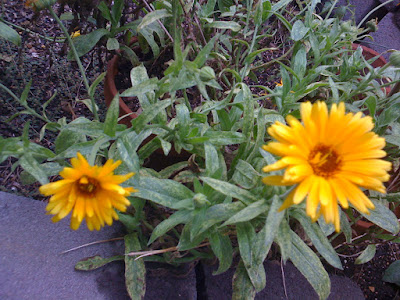
Gaillardia Amber Wheels is hardy and some times self sows on my patio. I saved seed last year and planted the seed again this year. It’s a hardy flower, still blooming it’s little head off. Next year I will grow more of these because the color is brilliant and they have a very long blooming period.

Petunia, Old Fashioned vining, (Petunia multiflora) a fragrant single petunia. Fragrant blossoms from June until after frost. This soft color would go with anything. I hope to collect seed and grow several of these next year. A hundred years ago, it was common in gardens, this is now considered a rare heirloom.


Potatoes and carrots

Potatoes and Carrots stew on this:

Both varieties are beautiful. and they are just the right size to make potato salad and roasting with meats and vegetables.

Seeds of change says, ” A 2 lb. order will plant approximately 20 row feet and yield about 15–20 lbs. of potatoes.”

I grew two kinds of potatoes.

Red Sangre Potatoes, Solanum tuberosum, Tender Annual – It is red-skinned with pure white flesh, and can be harvested early for abundant amounts of round, medium-sized tubers that are best prepared as creamed potatoes. Stores well. Maturity: Early-mid season 90-100 days. A 2 pound order of seed potatoes will plant 20 row feet and yields 15-20 pounds.

And, German Butterball, Solanum tuberosum, family Solanaceae First place winner in Rodale’s Organic Gardening “Taste Off.” A good choice for roasting, frying and mashed potatoes. Russeted skin and buttery yellow flesh. One of our favorite all-purpose potato. Excellent for long-term storage. 100-120 days. German Butterball were the big producers of the two, but both varieties under produced according to seeds of change predictions.This is their photo. I’ll have time to weigh and replace the photos tomorrow or the next day. I am not holding the Seeds of Change potatoes as guilty. Potatoes haven’t been sorted and weighed they are out in the shady yard curing. There will be one more taste test and potato evaluation. But, for now I just wanted to let you know that there was little disease. They might have produced more heavily with more rain and a bit more compost. Who is to say? More later with my own photos.

BLAH
BLAH
BLAH
Potato History:

Used by the Andean Indians for at least 2,000 years before the Spanish Conquest, the potato was introduced to Europe by the mid-16th century, and reputedly to England by the explorer Walter Raleigh. (Genus Solanum tuberosum, family Solanaceae.)

An obligatory lecture:

In Ireland, the potato famine of 1845, caused by a parasitic fungus, resulted in many thousands of deaths from starvation, and led to large-scale emigration to the USA. This is why you should always grow certified organic potatoes.

I’m telling two tales today, potatoes and carrots because this was my work out yesterday.

These are pale carrots I thinned and pulled to early. I though growing them in the light soils mix in the felt container, I was sure to have straight and beautiful rainbow and purple haze carrots. The squirrel kept digging the seeds up. So I grew the felt container under the wire basket you see in the back ground. I see that though the carrots are not nearly as log as the container is deep, they since the bottom and have started to ball up on the end.

They are not ready to be harvested, but it was good that I could this these few carrots. I might try this method again with the chorter carrot next year.

I tried two methods of growing potatoes. Some in raised beds. And these in the cloth containers. I was disappointed in the harvest amount, but it sure was easy harvesting – dump the soil upside sown and your potatoes spill out with the soil. They grew at about the same rate and were ready to harvest when the raised be potatoes were ready to harvest.
The taste rest and keeping ability will be another test, but for now, I believe I’ll try the German Butterball again next year.

Fragrance

Garden Royalty


Crown Princess Margareta, has loads of fragrant roses in late spring, then a few more continue to bloom, except in the hottest of summer. And, now there are even more light blooms that will continue till frost.
This little bloomer has many, larger flowers in spring. The roses are neatly formed rosettes of apricot yellow.

It is thriving in what I thought would be a temporary location with poor, rocky soil. But, it blooms where it was planted. So, the princess has found a permanent home. Each year, the top soil around the rose it gets a layer of leaf mould and compost. And because it is surrounded by asphalt on three sides, it always has a heaping helping of water-saving wood chip mulch.

In the spring, there are so many golden-yellow/apricot blooms, it perfumes the garden air.

The blossoms last month were petite and looked like miniature roses. Occasional blooms will appear now through the first frost. Blooms are just under 3″ across.

Crown Princess Margareta of Sweden was the granddaughter of Queen Victoria and was an accomplished landscape gardener who, together with the Crown Prince (later, King Gustavus VI Adolfus of Sweden), created the famous Swedish Summer Palace of Sofiero in Helsingborg.

David Austin Roses are a favorite of mine. After fifty years of rose breeding, David Austin’s English Roses combine the form and fragrance of old fashioned roses with the repeat flowering of modern roses. They are very easy to grow, healthy and reliable. I have very little disease problem with David Austin roses.

Find David Austin roses at Jackson & Perkins

Related Posts Plugin for WordPress, Blogger...